
The Algorithm of Extinction, Meta killing wildlife
My conscience forces me to write this as updates come through

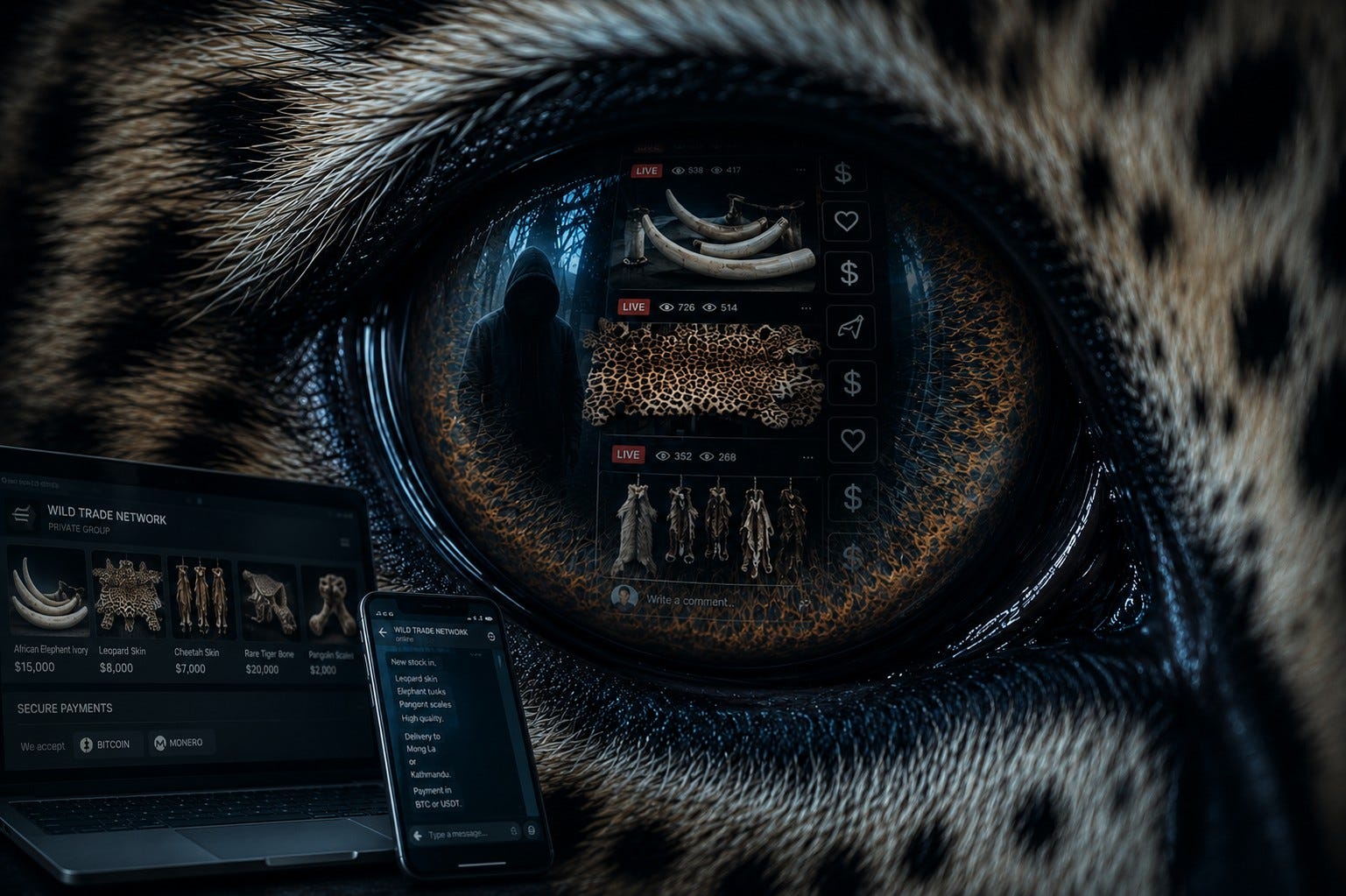
I’ve spent years writing about the illegal wildlife trade. I’ve documented the seizures, the trafficking networks, the corruption that allows it to flourish. But I have to be honest with you — I kept shaking my head with a range of emotions because of the scale of what we’re facing when I read the Clicks That Kill report. Since the release of the report and our own work with Blood of the Leopard, my conscience keeps me deep diving.
The numbers are staggering. Between April 2024 and March 2026, researchers detected 21,904 wildlife trafficking advertisements on Facebook alone, offering 266,535 wildlife products for sale . That’s not a few rogue accounts operating in the shadows. That’s an industrial-scale marketplace, and it’s hiding in plain sight. No one knows the true scale, just like seizures are only an indicator, these advertisements on Facebook that have been found are likely only a small percentage of what is really happening at the fingertips of wildlife killing criminals.
The report, released by a coalition of conservation organizations including Freeland, Education for Nature Vietnam, International Wildlife Trust, Liberia Chimpanzee Rescue & Protection, and PEGAS, accuses Meta of hosting the world’s “largest single known illegal wildlife trade market”. Nearly three-quarters of all online wildlife advertisements are concentrated on Facebook. The platform is now, in the words of the Global Initiative Against Transnational Organized Crime, “the central public infrastructure through which online wildlife trafficking is being concentrated, discovered and scaled”.
But here is the part that should stop us all in our tracks. The report does not simply document platform failure. It argues that Meta’s own systems are actively amplifying the trade.
Researchers documented instances where someone browsing an elephant ivory trafficker’s Facebook page was automatically introduced to additional accounts selling elephant tusks . Wildlife traders were recommended through Facebook’s “People You May Know” feature. Algorithms suggested similar wildlife-related profiles to users already engaging with such content . In effect, Meta’s recommendation systems perform the work of connecting buyers with sellers.
This is not neglect. This is acceleration.
And it gets worse. Through its Content Monetization programs—In-Stream Ads, Facebook Stars, and Creator Subscriptions—Meta financially incentivizes content creators to maximise post volume. The report presents circumstantial evidence that wildlife traffickers are enrolled in these programs . Some traffickers are effectively “double-dipping” by making money through Meta’s monetization while selling rare, protected animals.
Independent wildlife trafficking investigator Daniel Stiles put it bluntly: “This content monetization that Facebook and Instagram push is actually incentivizing people to commit illegal acts. The more interaction and engagement they get on their account, the more money they can make”. He called the situation “mindboggling”.
And here is another truth that must be spoken: Meta has dismantled its own enforcement capacity. In January 2025, it eliminated independent fact-checkers. In March 2026, it announced the phaseout of human content moderators in favour of Artificial Intelligence . The report documents that warnings issued to trafficking accounts are routinely ignored, and traffickers whose accounts are suspended typically resume business on a new account within 24 hours .
Steven Galster, founder of Freeland, stated: “Meta’s platforms have become a one-stop shop for wildlife criminals. The algorithms don’t just allow this trade — they fuel it. Meta can and must halt this illegal business now and be held accountable”.
I have written extensively about the different actors involved in wildlife trafficking, and the responsibility that lies with governments and consumers across the world. But this is different. This is one of the most powerful corporations in history, whose business model has evolved to actively promote the destruction of endangered species.
The coalition is calling on three actors to take immediate action: Meta must enforce its own policies and stop monetizing trafficking accounts; the U.S. Congress must amend Section 230 to include a carve-out for illegal wildlife trade; and governments and NGOs worldwide must invest in Open-Source Intelligence capacity to monitor and report online trafficking .
Meta was among 11 tech firms that announced this month they would work to eliminate wildlife trafficking on their sites. But the company has been a member of the Coalition to End Wildlife Trafficking Online since 2018, and the problem has continued to grow . Galster warned the latest announcement risked being “more lip service” . “Until Meta is compelled to rid its platforms of illegal wildlife trade, and prove that it is not profiting from it, the online wildlife trade will only get worse.”
We have updated the Blood of the Leopard section on the online marketplace to reflect these findings and will continue to evolve as this story develops, part of the living document action.
Big cats and countless other species cannot afford for us to look away from the screens that are selling their futures. The tools to detect and remove illegal wildlife content exist. The policies to ban it are already written. What is lacking is the will to enforce them consistently and proactively.
This is not just about technology. It is about accountability. It is about whether we allow the algorithms that run our lives to drive species to extinction. And it is about whether we have the courage to demand that the platforms stop profiting from extinction.
Hope springs from the exposure of the wrongs of those such as Meta. But hope without action is just another word for regret.
Wildlife deserves better. And so do we.
Footnote: As much as I’d like to believe that calling for a boycott of Meta platforms would lead to that actually happening, I’m not that naive. There isn’t enough care for that to happen. It grates me that through necessity I still use Meta but I do it as sparingly as possible. I do invite those who contact me through WhatsApp to switch to Signal, it’s the same phone number — people have already responded to that, thank you.
Wildlife trafficking is slipping under the radar the same way climate issues did for so long. As I look out at a Himalaya with little snow, something we were warned would happen if there was not action, I fear of habitats with no wildlife — that is already happening. That fear drives me to keep going and I do believe we can win this thing, I wouldn’t be sending this to you at around 4am if I thought otherwise.
Your article certainly should be a wake-up call for those who don’t realize the magnitude of the wildlife trafficking problem. Thank you for writing this.
Meta is a criminal enterprise. Zero interest to clean up. This has been going for so many years and the illegal trade on FB and Insta just continues to spiral out of control. It's beyond frustrating that to date we have failed to hold them accountable. Thanks for writing about this, Jack.